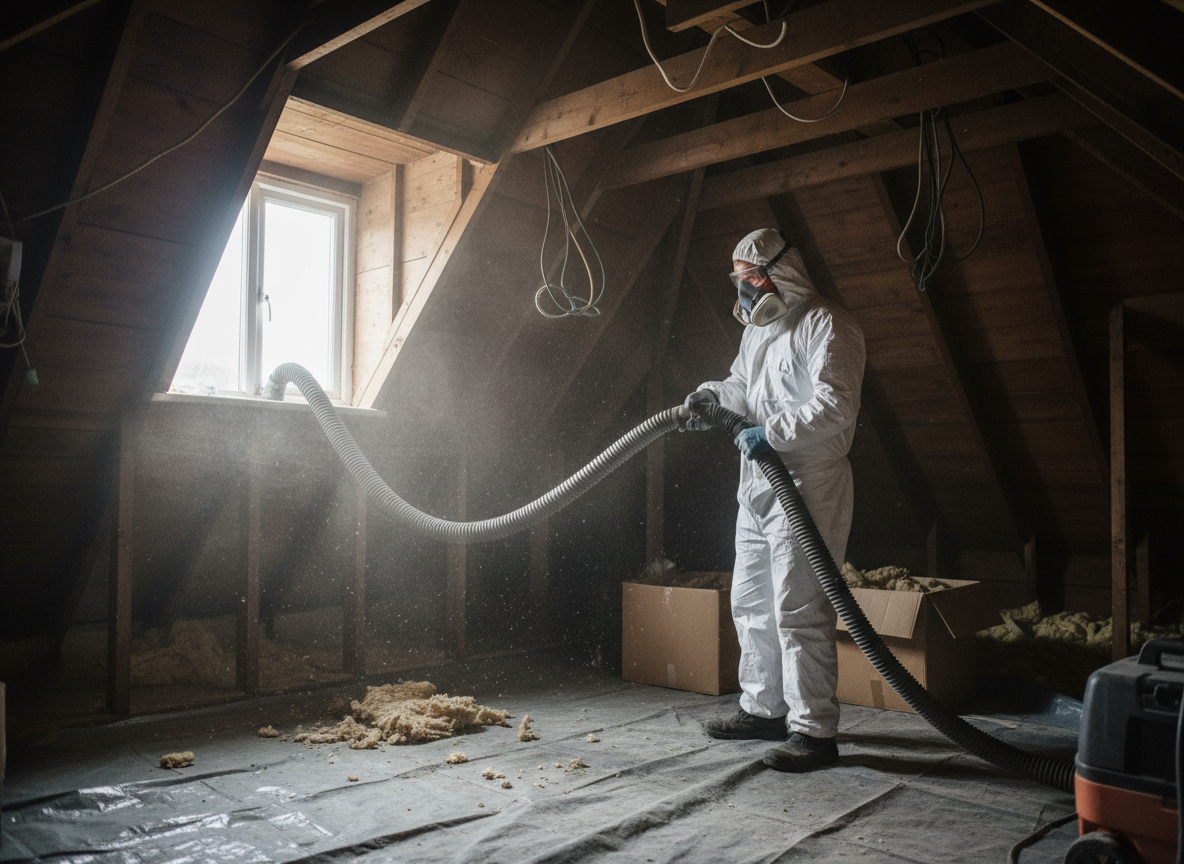
Huddersfield's Victorian terraces and early 20th-century stone houses often received spray foam in the 2000s to meet energy targets. Over time the foam traps damp against the masonry because many of these buildings lack modern vapour barriers. Removal requires cutting access hatches through ceilings without disturbing original lath and plaster, then using negative-air machines to contain dust that would otherwise settle in neighbouring rooms.
West Yorkshire winters bring prolonged rainfall and high humidity that saturates foam bonded to roof decks. Once wet the material loses R-value and can promote rot in timber joists. Technicians must peel the foam in sections while monitoring joist moisture levels, then install temporary ventilation until new insulation is chosen. In properties near the canal basin or on sloping ground around Lindley and Marsh, water ingress paths are more common and demand extra inspection of wall plates.
Local building control expects waste foam to be segregated from general rubble because it contains isocyanates. Crews bag the material on site and arrange licensed disposal rather than sending it to standard skips. Homeowners in HD1 and HD2 postcodes frequently discover the foam also blocks loft ventilation needed for condensation control, so the job includes restoring airflow before any new insulation is discussed.
Technician insight
In Huddersfield the thing that catches most people out with insulation removal service is the way closed-cell foam was sprayed right up to the eaves in 1930s semis around Birkby and Fartown. Those narrow voids trap water against the stone and the foam hides it until you start peeling; once you open the space you often find the wall plate already softening.
Hidden Damp in Marsh Terrace
Homeowner noticed musty smell in the bedroom below the loft. We found closed-cell foam bonded to a saturated roof deck above a 1920s stone terrace. After section-by-section removal we discovered rot beginning at the wall plate; we extracted all foam, dried the timber, and advised on breathable alternatives before closing the space.
How it works
- 1
Site Assessment
Inspect roof structure, measure foam depth, and check for hidden damp in Huddersfield stone terraces.
- 2
Containment Setup
Install negative air and floor protection to stop dust migrating through shared chimney stacks and party walls.
- 3
Foam Extraction
Cut and peel foam in controlled sections while monitoring joist condition and moisture readings.
- 4
Waste Removal and Ventilation
Bag material for licensed disposal and restore loft airflow before handover.
Pricing
Cost varies with access difficulty, foam thickness, and whether multiple rooms are involved.