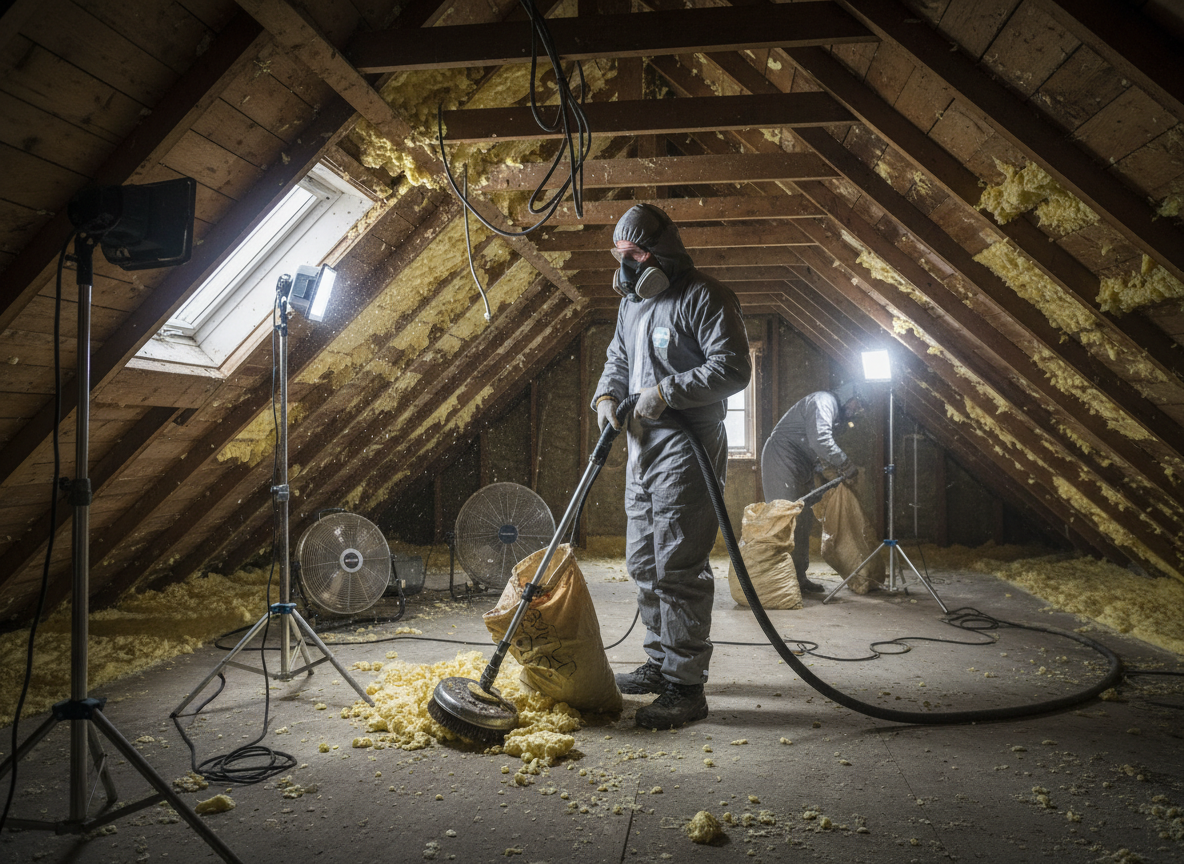
Huddersfield’s Victorian terraced houses and early 20th-century stone properties often received spray foam insulation in lofts and wall cavities during the 1990s and 2000s. Over time the foam can trap moisture against the original masonry, leading to timber decay and reduced breathability in solid-wall construction. Removal requires cutting the material into manageable sections while protecting existing lath and plaster ceilings that are common in these homes.
West Yorkshire weather brings frequent rain and high humidity, which makes foam removal more delicate because saturated foam releases more dust and can stain joists. Crews work from the 12 Station St base and travel into areas such as Lockwood, Paddock and Newsome where narrow ginnels limit equipment access. Negative-air machines and sealed chutes are used to keep insulation particles out of living spaces below.
Local building control expects that any cavity work in pre-1919 properties leaves the structure able to dry naturally. Technicians therefore avoid aggressive scraping that damages the inner brick skin and instead peel foam back in layers, checking for hidden damp proof course breaches that are frequent along the Colne valley floor.
After extraction, lofts are left clean enough for new insulation or for the original ventilation to be restored. Homeowners in the HD1 and HD4 postcodes regularly request this service when selling or when roof leaks appear years after the foam was installed.
Technician insight
In Huddersfield the thing that catches most people out with Spray Foam Removal near me is how the foam bonds to the lime mortar in 1890s terraces along the Colne; once it pulls away it often leaves the pointing friable and the joist ends exposed to the damp that rolls in from the Pennines every autumn.
Lockwood Terrace Loft
Foam in a 1905 two-up two-down had started to hold roof leaks against the ceiling joists. We found water staining along the rear wall plate and loose sections of lath. The foam was cut back in strips from the access hatch, vacuumed clean, and the loft left ventilated so the timber could dry before the owners arranged new insulation.
How it works
- 1
Site Assessment
Inspect loft or wall cavities, identify foam type and depth, note any timber or plaster damage.
- 2
Containment Setup
Seal rooms below, install negative air and dust chutes from the Station Street van.
- 3
Foam Extraction
Cut and remove foam in sections, vacuum residue from joists and masonry.
- 4
Final Clean and Check
Remove all debris, inspect for damp issues, advise on next steps for the property.
Pricing
Cost depends on property age, foam thickness and access difficulty in Huddersfield stone terraces.