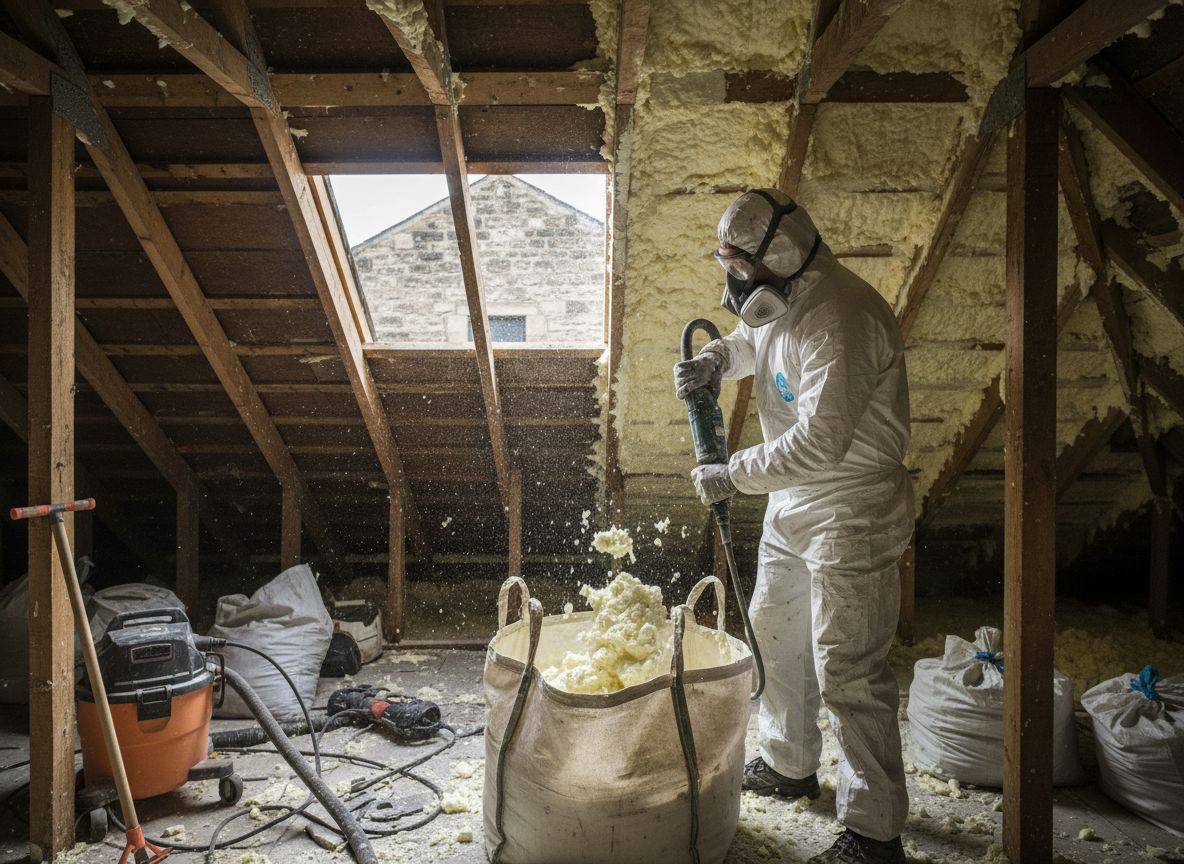
Huddersfield's Victorian terraced houses and Edwardian semis around the town centre and areas like Lindley and Marsh often received spray foam in the 2000s to meet energy targets. Over time the closed-cell material traps moisture against original timber joists and slate roofs, leading to rot that only shows when ceilings stain or lofts are inspected. Removal requires cutting the foam into manageable sections without disturbing wiring or pipework that runs through the joists, then bagging it for licensed disposal at local West Yorkshire facilities.
West Yorkshire's frequent rainfall and high humidity mean any remaining foam residue can restart condensation cycles within weeks. Technicians working from 12 Station St Huddersfield HD1 1LN carry negative-air machines and seal loft hatches before cutting begins, preventing particles from drifting into living spaces below. Edge cases include foam that has bonded to old lath-and-plaster ceilings; these demand slower hand tools and temporary propping to avoid collapse.
After foam extraction the loft is left clear for new insulation or ventilation upgrades. Homeowners in the HD1 and HD2 postcodes frequently discover the original roof felt has deteriorated underneath the foam, requiring immediate repairs before winter. The 24/7 availability allows jobs to start the same day when water ingress is reported, limiting further damage to ceiling timbers.
Common Loft Conditions in Huddersfield Properties
Older stock in the Huddersfield area often features narrow access hatches and low eaves that limit equipment size. Removal crews adapt by using sectional scaffolding and smaller vacuums suited to tight roof voids common in terraced rows.
Technician insight
In Huddersfield the thing that catches most people out with loft spray foam removal is how quickly the foam has pulled moisture into the original roof timbers on north-facing slopes; once winter rain hits those saturated joists the rot spreads fast if the foam is left in place.
Lindley Terrace Loft Clearance
Homeowner noticed ceiling stains after heavy rain. Inspection found closed-cell foam bonded to 1920s joists with active rot along the eaves. Crew removed the foam in sections, treated the timber, and cleared debris without disturbing the slate roof. Property now has restored loft ventilation and no further moisture issues.
How it works
- 1
Initial Loft Inspection
Assess foam thickness, joist condition, and any wiring or pipe interference in the specific property.
- 2
Containment Setup
Seal the loft space and install extraction equipment to keep dust out of living areas.
- 3
Foam Sectioning and Removal
Cut and bag the spray foam in controlled sections for safe transport and disposal.
- 4
Final Clearance and Check
Vacuum residue, inspect timbers, and confirm the loft is ready for new insulation or repairs.
Pricing
Cost depends on loft size, foam depth, and access difficulty; quotes provided after inspection.